
More than three years after ChatGPT first launched, the AI assistant space has become highly competitive, with millions of users now spread across several platforms. According to Sensor Tower’s 2026 State of AI Report, OpenAI’s ChatGPT is still the leading assistant globally, but its dominance has weakened significantly as users explore alternatives like Google’s Gemini, Anthropic’s Claude, xAI’s Grok, and others.
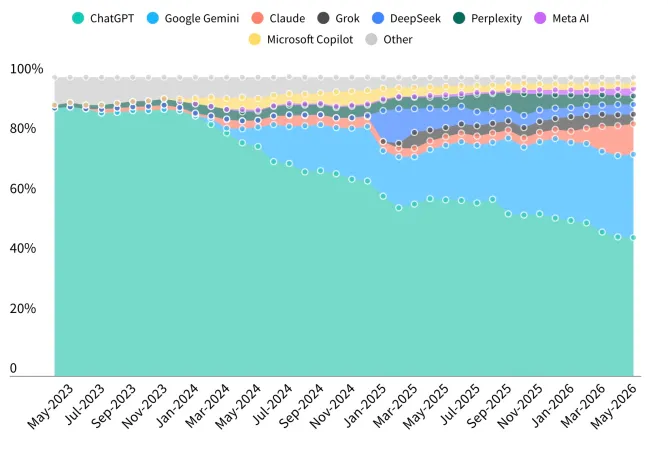
At its peak, ChatGPT held more than half of the market. But by May 2026, its share had fallen to 46.4%, marking the first time it dropped below the 50% threshold. During the same period, Gemini grew to 27.7% and Claude reached 10.3%, showing that competition is no longer limited to just one dominant player. Smaller assistants such as Grok, Perplexity, DeepSeek, and Meta AI continue to compete for a smaller portion of the market, each holding under 5%.
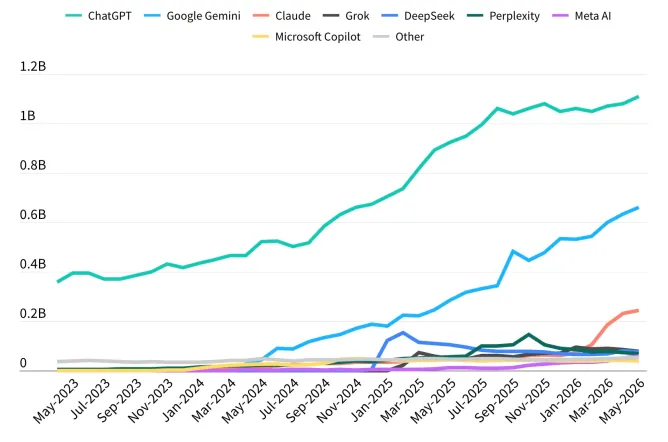
Despite the decline in share, ChatGPT’s overall user base continues to grow at scale. Sensor Tower reports that the app became the fastest to reach 1 billion monthly users globally. OpenAI also previously reported 900 million weekly active users earlier in 2026, showing that usage is still extremely high even as competition increases. By comparison, Gemini now has around 662 million monthly users, while Claude sits at 245 million.
The report highlights a major shift in user behavior: people are no longer committed to a single assistant. Instead, they switch depending on the task, ecosystem, or even trust in the company behind the product. For example, OpenAI reportedly saw a spike in uninstall activity after announcing a deal with the U.S. Department of Defense, suggesting that user values and perception now play a bigger role in platform choice.
Gemini’s growth has been strongly supported by its deep integration into Google’s ecosystem, making it a natural default for many Android and Google Workspace users. Claude, on the other hand, has built a reputation around productivity and writing tasks, helping it achieve one of the highest subscription conversion rates in the industry, with about 13% of users paying for premium access.
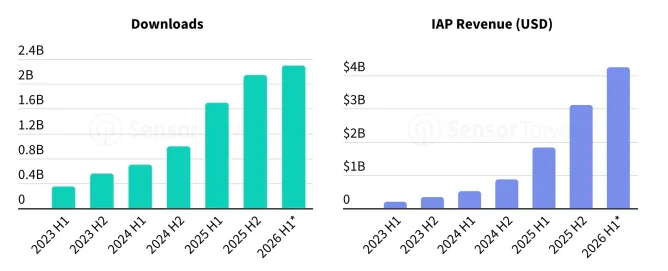
Globally, AI adoption continues to rise at a massive pace. In the first half of 2026 alone, users are expected to download about 2.3 billion AI apps and spend over $4.2 billion on them, nearly doubling the spending seen in the same period the year before. However, Sensor Tower notes that growth rates are starting to slow, suggesting the market is moving from rapid expansion into a more mature phase.
Regional trends also show clear differences in usage. Asia, which leads in total downloads, recorded its first decline in early 2026 due to drops in China and India. Meanwhile, North America and Europe continue to dominate in in-app spending, where users are more likely to pay for premium AI features.
In the United States, AI assistants are increasingly being used for productivity and shopping-related tasks. Average revenue per user is rising across the industry, but Claude stands out with one of the strongest monetization performances. At the same time, total engagement is exploding, with users expected to spend more than 36 billion hours across AI apps in 2026, compared to 17.2 billion hours the year before.
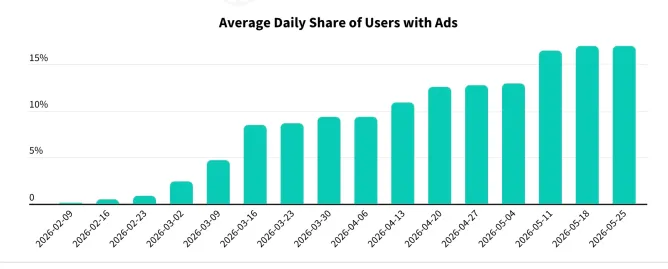
ChatGPT is also experimenting with new revenue streams beyond subscriptions, including ads introduced in early 2026. By May, around 17% of daily users were being shown advertisements. The biggest ad categories include software, retail, media, and food services, showing how AI assistants are gradually becoming commercial platforms, not just tools.
As AI assistants evolve into shopping and recommendation engines, they are beginning to influence real-world consumer behavior. ChatGPT is already sending traffic to major retailers like Walmart, Target, and Costco, while Amazon has limited its exposure by restricting access to its systems. Some companies are even building their own AI shopping tools, signaling a broader shift toward AI-driven commerce across the retail industry.
Overall, the report shows a clear trend: ChatGPT remains the leader, but the AI assistant market is no longer a one-player race. Instead, it is rapidly evolving into a multi-platform ecosystem where user choice, trust, and integration matter just as much as raw capability.