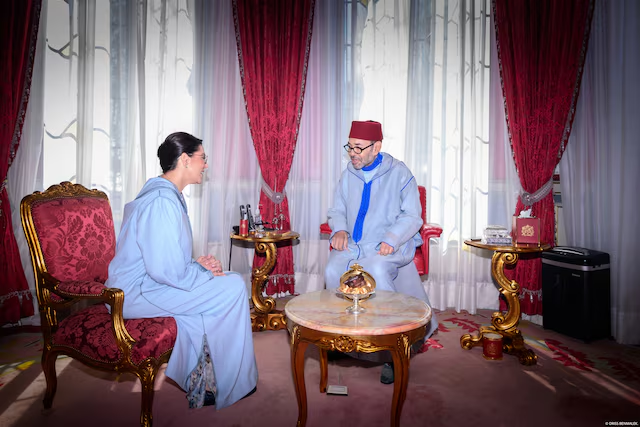

Morocco has reached a historic moment in its political history after King Mohammed VI appointed Fatima Ezzahra El Mansouri as the country’s first woman head of government.
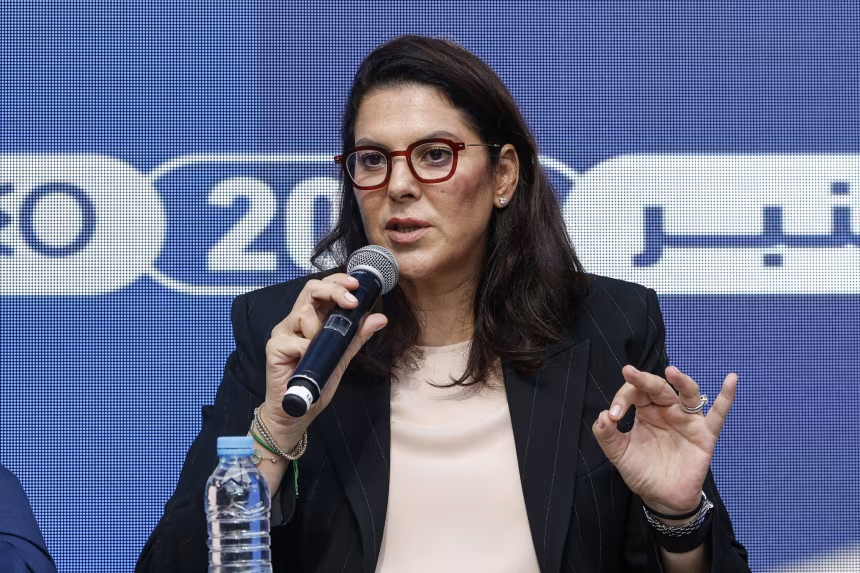
The appointment was announced on September 29, following the September 23 parliamentary election in which El Mansouri’s Authenticity and Modernity Party (PAM) emerged as the largest party in the House of Representatives. The king has tasked her with forming the next government and presenting its members for approval.
El Mansouri’s appointment marks the first time a woman will lead Morocco’s government. She succeeds Aziz Akhannouch, who had served as head of government since 2021.
The new head of government is a lawyer and experienced politician who has held several senior positions. She previously served as Morocco’s minister responsible for territorial planning, urban planning, housing and city policy, and has also served as mayor of Marrakech.
Her political career also has strong ties to PAM. The party was established in 2008 by Fouad Ali El Himma, an adviser to King Mohammed VI, and has generally positioned itself around social modernization and centrist politics.
PAM won 97 of the 395 seats in Morocco’s House of Representatives, finishing ahead of the National Rally of Independents (RNI), which secured 66 seats, and the Istiqlal Party, which won 65.
The Justice and Development Party (PJD), led by former prime minister Abdelilah Benkirane, finished with 54 seats and has said it will remain in opposition.
Morocco operates as a constitutional monarchy, meaning political power is shared between elected institutions and the monarchy. The king retains important responsibilities, including key areas of foreign policy and defence.
Under Article 47 of Morocco’s constitution, the monarch appoints the head of government from the political party that wins the largest number of seats in the House of Representatives. PAM’s first-place finish therefore placed El Mansouri’s party at the center of the government-formation process.
However, PAM did not win enough seats to govern alone. The 395-member chamber requires 198 seats for a majority, meaning El Mansouri must negotiate with other parties to build a governing coalition.
Coalition talks could involve parties that previously worked alongside PAM, including the RNI and Istiqlal. The three parties together hold 228 seats, although the final composition of the government will depend on negotiations and the distribution of cabinet positions.
The coalition process is particularly notable because PAM and the RNI had previously disagreed over several policy issues. During the election campaign, PAM had ruled out continuing its previous coalition arrangement with the RNI.
After the election, however, El Mansouri indicated that she was prepared to approach the negotiations differently.
“We have turned the page,” she said.
She also indicated that there would be no "red lines" when it came to discussions with other parties, opening the possibility of a broader coalition as she works to assemble the next government.
Fouzi Lekjaa, president of Morocco’s Royal Moroccan Football Federation and a former budget official, had also been discussed as a possible candidate for the head of government before El Mansouri received the appointment. Lekjaa joined PAM shortly before the election and was credited with helping strengthen the party’s campaign.
The new government will inherit several major responsibilities, including the final stages of Morocco’s preparations for the 2030 FIFA World Cup.
Morocco will co-host the tournament with Spain and Portugal, and the country is overseeing a multibillion-dollar investment program to upgrade infrastructure and prepare for the global event. Reuters reported that the incoming administration will oversee the final stages of a roughly $20 billion preparation effort.
Beyond the World Cup, El Mansouri’s government will face pressure to address economic concerns, particularly among younger Moroccans.
Youth dissatisfaction has become an important issue in Morocco, with recent protests focusing on public services, including healthcare and education. The political debate has also been shaped by concerns about employment, living costs and the distribution of government spending.
The September election itself recorded significantly lower participation than the previous parliamentary vote. Turnout was about 38%, compared with roughly 50% in 2021, making voter participation one of the key issues surrounding the election.
The lower turnout has been closely watched because participation is often viewed as an indicator of public engagement with elected institutions. The election therefore produced both a change in the parliamentary balance and questions about why fewer voters took part.
El Mansouri’s appointment also follows a gradual increase in the number of women holding senior public positions in Morocco. Women have previously served in ministerial and other prominent institutional roles, with four women serving in the outgoing cabinet.
Her appointment nevertheless represents a significant change at the highest level of Morocco’s elected government. She now becomes the first woman entrusted with forming and leading a Moroccan government.
The immediate challenge is forming a cabinet capable of securing parliamentary support. Once coalition negotiations are completed, El Mansouri will submit her proposed government for royal approval.
The new administration will then take responsibility for a country preparing for one of the world’s biggest sporting events while also dealing with economic pressures and demands from a younger population.
For Morocco, the appointment of El Mansouri adds a historic milestone to a political transition that began with the September 23 parliamentary election. Her success in forming a coalition and governing will now determine the next stage of the country’s political direction.