
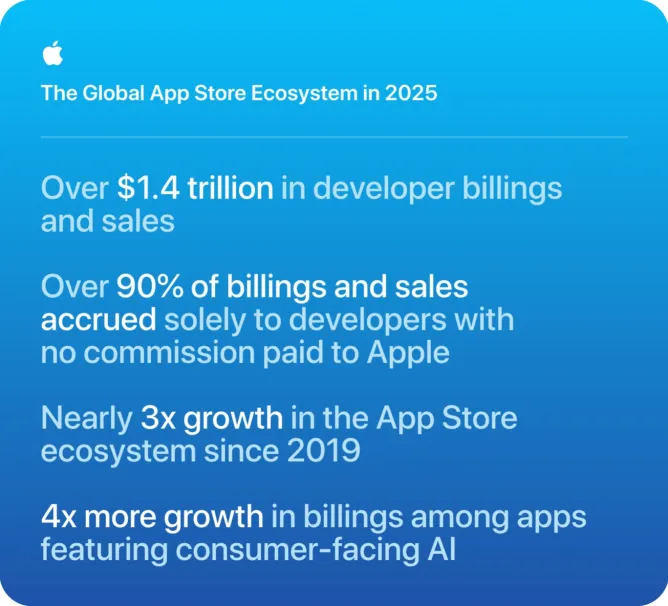
Apple has released its annual update on the App Store economy ahead of its Worldwide Developers Conference, revealing that its platform supported more than $1.4 trillion in developer billings and sales in 2025. This marks an increase from the $1.3 trillion reported the previous year.
The figure includes all transactions made through apps on Apple devices, covering everything from digital purchases to real-world services. Apple uses this data to show how the App Store helps developers generate income beyond just in-app purchases, including physical goods, subscriptions, and advertising.
The company emphasized that about 90% of the $1.4 trillion in activity did not involve any commission paid to Apple. This is because most of the value comes from physical goods and services sold through apps, which are not subject to App Store fees.
Breaking down the numbers further, Apple said $1.1 trillion came from physical goods and services such as retail shopping, food delivery, ride-hailing, and travel bookings. Another $149 billion came from digital goods and in-app purchases, which is the category where Apple typically takes a 15% to 30% commission depending on the developer and transaction type.
Advertising revenue inside apps also played a role, generating around $151 billion in 2025, slightly up from the previous year.
Apple reported that the App Store averaged over 850 million weekly users across 175 countries, showing its continued global reach.
The company also highlighted the growing importance of artificial intelligence apps, noting that 40 of the top 100 apps now include AI features. These apps saw stronger growth in billing compared to others, signaling a shift toward AI-driven mobile experiences.
This comes as Apple is expected to make major AI-related announcements at WWDC, including a possible Siri overhaul and deeper AI integration across its devices. There are also ongoing rumors that Apple may open the App Store further to AI agents in the future.
Apple also pointed to strong regional growth, saying App Store-driven billings have more than doubled in China over the past six years, while the United States and Europe have seen more than triple growth over the same period. Most of this expansion is driven by physical services like e-commerce, transport, and delivery platforms.