
Meta’s personal AI agent Muse is still in its early stages, but the company is already expanding its capabilities at a rapid pace. Just weeks after its launch, Meta used its annual Connect event to reveal a series of new features designed to make Muse more useful across work, shopping, communication and everyday life.
CEO Mark Zuckerberg made the company’s direction clear during his keynote in Menlo Park, presenting Muse as one of Meta’s biggest bets in consumer AI. The company is building the agent to work across users’ devices and connect with the apps and services they already rely on.
Muse can already interact with services such as email and calendars, but Meta wants it to become much more than a chatbot. The long-term goal is an assistant that can perform tasks, manage digital work and continue working in the background after a user gives it an instruction.
Muse launched in early September and is powered by Muse Spark, Meta’s multimodal AI model designed for agentic tasks. The company has positioned it as an accessible personal assistant that can take over some of the repetitive work people deal with every day.
“The centerpiece of our vision for what we’re building is Muse,” Zuckerberg said as he kicked off a keynote donning khakis and a black T-shirt with the words “Building is My love Language” emblazoned across the front. “In the coming years, I expect that Muse is going to grow into the personal superintelligence that billions of people around the world are going to use to accomplish their goals and improve their lives.”
Meta is also looking at ways to turn Muse into a business. Zuckerberg said the company plans to offer a large amount of access to the service for free while eventually generating revenue from transactions handled through the agent.
“We’re standing behind this by making Muse free for a huge number of tokens, with the expectation that over time we will profit by taking a small fee from transactions,” he said.
Here are some of the biggest new features Meta announced for Muse.
Muse Gets Its Own Digital Avatar

One of the more visual additions is a new digital avatar that will give Muse a face, body and voice. Instead of interacting with an AI that exists only through text or audio, users will eventually be able to create a distinct avatar for their personal agent and communicate with it through live video.
Meta says the experience will be powered by a new AI model called Muse Realtime Avatar. The technology is designed to generate the avatar and allow it to respond during conversations in real time.
Users will be able to speak with their avatar, ask questions and give it tasks while watching it respond on screen. The idea is to make Muse feel more like a digital companion rather than a traditional software assistant.
The feature also brings some of Meta’s earlier virtual-world ambitions into its current AI strategy. Instead of building an entirely separate virtual environment, Meta is putting a digital character directly around its AI assistant and giving users a more personal way to interact with it.
Muse Is Coming to Meta’s Smart Glasses
Meta is also bringing Muse to its smart glasses, allowing users to interact with the AI without reaching for their phones.
Once the feature becomes available, users will be able to activate Muse with a wake word and speak directly to the glasses. The assistant will then be able to help with tasks based on what the user is doing and what they ask it to accomplish.
Meta demonstrated several potential uses, including personalized workouts, meal logging, appointment booking and shopping. If a user sees something they want to buy, Muse could also help them find and purchase the product.
The company says Muse will be able to continue working in the background rather than requiring the user to remain engaged throughout the entire process. Once the task is completed, the assistant can check back in with the user.
Meta has not announced an exact launch date for the glasses integration, but says it is expected to arrive in the coming months.
Muse Will Be Able to Run Your Mac
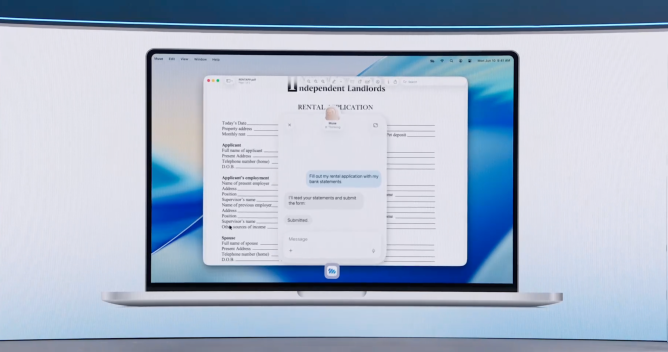
Meta is also expanding Muse beyond phones and wearable devices by bringing computer-control capabilities to Mac.
The feature will allow users to hand tasks over to Muse and let the AI operate applications on their desktop. Rather than simply answering questions or generating content, Muse will be able to interact with software and carry out multi-step tasks.
That could make the feature useful for both personal and professional work. A user could delegate a series of jobs to Muse and leave the computer while the agent continues working.
“You can have it help you run your small business, or just get work done for you,” Meta’s chief AI officer Alexandr Wang said Wednesday during the keynote. “You can walk away from your computer and it keeps working for you on all the jobs you lined up.”
The approach puts Muse in the same broader category as AI agents that can operate computers on behalf of users. Meta’s goal is to move the assistant from simply providing information to actually completing digital work.
Muse Will Get Its Own Email Address
Meta is also developing an email address specifically for Muse.
The feature is designed to make it easier for the agent to communicate with people and services while handling tasks in the background. Users will eventually be able to include Muse in email conversations or forward messages to it when they want the AI to take care of something.
For example, instead of manually managing an email exchange, users could bring Muse into the conversation and have it handle the relevant task on their behalf.
Meta’s Alexandr Wang said the feature is coming soon, although the company has not provided a specific release date.
Muse Is Expanding Into Shopping
Shopping is another major area where Meta wants Muse to become more capable.
The company has partnered with major commerce and payment platforms, including Stripe and Shopify, allowing Muse to interact with product catalogs and assist with purchases.
According to Wang, Muse can access Shopify’s product catalog and use Lync and Shop Pay to complete purchases. Meta has also expanded support for PayPal, giving users more options when paying for products through the agent.
The company is also working directly with major retailers. New partnerships include Best Buy, Gap, Sephora, Walmart and Wayfair, while integrations with Expedia and soon Instacart will expand Muse’s reach into travel and grocery shopping.
These connections are important because they move Muse beyond recommending products. The goal is for the agent to search, compare and eventually complete transactions for users.
Muse Is Connecting to More Apps
Meta is also building a larger network of third-party services that Muse can interact with.
In addition to retailers and shopping platforms, the company announced connectors for services including GitHub, Granola and Notion. These integrations could allow Muse to work with information and tasks stored across different platforms instead of operating as a standalone assistant.
The company also wants smaller businesses and independent developers to participate in the ecosystem. Meta recently opened its platform so developers can create their own connectors, allowing Muse to work with additional services.
According to Wang, the response has already been significant. He said Meta received more than 1,500 applications within less than a week from developers interested in building connectors.
“I think this could be a generational opportunity to start building for a new platform as it takes off, and the response so far has been really great.”
The strategy gives Meta a way to expand Muse without having to build every integration itself. If more developers create connectors, the agent could eventually work across a much wider range of services and business tools.
Meta Wants Muse to Work in the Background
The common thread across many of these announcements is that Meta wants Muse to do more than simply respond when someone asks a question.
The company is building the agent around the idea of delegation. Users can give Muse a task, allow it to work across connected services and return later for the result.
That could include managing emails, organizing schedules, operating computer applications, finding and purchasing products, interacting with business tools or helping with tasks through Meta’s smart glasses.
This approach would make Muse less like a conventional chatbot and more like a digital assistant capable of taking action.
Meta is still developing many of these features, so the exact capabilities available at launch may change. But the direction is clear: the company wants Muse to become deeply connected to the digital services people use every day.
With avatars, smart glasses, computer control, email, shopping and third-party connectors all being added to the platform, Meta is rapidly turning Muse into a broader AI ecosystem rather than a single chatbot.
For Meta, the larger ambition is to make Muse available wherever users need it, whether they are sitting at a computer, shopping online, managing work, checking their schedule or simply talking through their smart glasses.